Source Oven Gloves for Baking, Grilling, and Kitchen Use
Compare 30 oven gloves from verified suppliers featuring heat resistance, food-grade materials, and customization options. Buyers can evaluate specs like size, material, and packaging to find the right solution for industrial or household needs.
Key considerations
Products List





Comprehensive Sourcing Guide
Strategic Sourcing Guide for Industrial and Commercial Oven Gloves
Procuring oven gloves for commercial kitchens, industrial baking facilities, and household appliance distribution requires a rigorous approach to material selection, compliance verification, and supplier evaluation. The market for heat-resistant protective gear is diverse, ranging from simple cotton liners to complex multi-layer composites involving silicone and acrylic. Buyers must navigate a landscape where product attributes vary significantly between models, often within the same supplier catalog. This guide outlines the critical factors for sourcing oven gloves, focusing on technical specifications, material integrity, and supply chain reliability based on observed industry data.
Material Composition and Thermal Performance
The primary determinant of an oven glove's utility is its material composition. Observed product listings reveal a spectrum of materials, including cotton, nylon, polyester, acrylic, and PVC. Each material offers distinct thermal and tactile properties that dictate its suitability for specific applications. Cotton is frequently cited as a base material, often valued for its breathability and comfort during prolonged wear. However, cotton alone may lack sufficient thermal resistance for high-temperature industrial environments unless treated or layered.
In contrast, products utilizing nylon and polyester often emphasize durability and abrasion resistance. Specific model data indicates the presence of "Abrasion Resistant" features in nylon-based gloves, suggesting these are better suited for environments involving frequent contact with rough surfaces or repeated handling of hot metal racks. Acrylic is another observed material, potentially offering a balance between softness and heat retention.
For applications requiring direct contact with high-heat surfaces or liquids, silicone-coated or silicone-integrated gloves are critical. The attribute "Heat Resistant Silicone Oven Mitt" highlights a specific functional category where silicone provides a superior barrier against thermal transfer. Additionally, the outer material specification of PVC appears in certain listings, which may offer enhanced liquid resistance and ease of cleaning, though buyers must verify the specific temperature limits of the PVC formulation used.
The thickness of the glove is a crucial specification. Data points indicate "Thickened" variants are available, which generally correlate with higher thermal insulation capabilities. A "Medium" length specification is also observed, but buyers should verify if this meets the required wrist coverage for their specific safety protocols. The "Loose" cuff tightness noted in some specifications suggests a design prioritizing ease of donning and doffing, which is beneficial in fast-paced kitchen environments, though it may offer less protection against splashes compared to tighter cuffs.
Technical Specifications and Sizing Standards
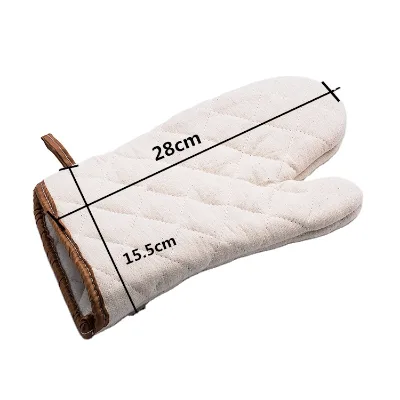
Standardization in sizing is often a challenge in the oven glove market. Observed data shows a lack of uniform sizing conventions, with listings specifying "M" (Medium) and "XL" (Extra Large) alongside precise dimensional measurements such as "7.5*11.4 Inch." This discrepancy necessitates careful verification of dimensions before bulk ordering. Relying solely on generic size labels like "M" can lead to fit issues, particularly when sourcing from different suppliers.
The physical dimensions of the product are equally important for storage and logistics. The "Single package size" of "24X20X10 cm" and "Single gross weight" of "0.200 KG" provide essential data for freight calculation and warehouse planning. Buyers must also consider the "prod_packing" details, which range from individual polybag packaging to bulk carton configurations. One specific listing notes a packing detail of "1 pair/opp bag for our oven gloves, 100 pcs oven gloves in a carton," while another mentions a carton size of "503030cm." These variations significantly impact shipping costs and storage efficiency.
Furthermore, the "Thickness" attribute, described as "Thickened" in some contexts, should be cross-referenced with the intended use. For instance, a glove designed for "Household Electrical Appliances" may have different thickness requirements compared to one intended for heavy-duty industrial oven use. The "Length" being "Medium" suggests a standard coverage, but buyers should confirm if this extends sufficiently to protect the forearm, a common requirement in professional baking settings.
Compliance, Safety Standards, and Certifications
Safety compliance is paramount when sourcing protective equipment. While the provided data mentions general standards like "EN 388" and "EN 374" in the background context, these should be treated as reference points for verification rather than guaranteed attributes of every listed product. EN 388 typically covers mechanical risks, while EN 374 addresses protection against chemicals and liquids. Buyers must explicitly request test reports confirming that the specific oven glove model meets the relevant thermal resistance standards for their jurisdiction.
The attribute "Food Grade" appears in multiple listings, indicating that certain gloves are suitable for direct contact with food products. This is a critical distinction for kitchen environments where gloves may inadvertently touch food items. However, "Food Grade" is a broad term; buyers should verify the specific regulatory compliance, such as FDA or EU food contact regulations, depending on their target market. Similarly, the "Eco-friendly" and "Sustainable" attributes observed in some listings require validation through recognized environmental certifications, as these claims can vary in rigor.
Certifications like CE are mentioned in the background as potential standards, but their presence cannot be assumed for all products. Buyers should demand proof of certification for any claim of compliance. The "prod_standard" is listed as "customized" in some instances, which implies that the product may be tailored to meet specific client requirements rather than adhering to a universal industry standard. In such cases, the buyer's specifications become the de facto standard, and the supplier must demonstrate their ability to meet those exact parameters.
Cost Drivers and Procurement Economics
The cost of oven gloves is influenced by several variables, including material complexity, customization level, and order volume. The observed price range of $0.1 to $20 USD reflects this variability, with lower prices likely corresponding to basic cotton or polyester models and higher prices associated with specialized silicone or multi-layer constructions. The "MOQ" (Minimum Order Quantity) is a significant cost driver. While some listings show an MOQ of 10, others indicate a much higher threshold of 10,000 units. This disparity suggests that suppliers may have different production capabilities or target different market segments, from small retailers to large industrial distributors.
Customization is a major factor in pricing. The attribute "Customization: Available" and "OEM: Yes" indicates that buyers can request custom branding, logos, and packaging. The "Custom Logo" and "Style: Printed" options allow for brand differentiation but often incur additional setup costs and may increase the MOQ. The "prod_packing" customization, such as specific carton sizes or individual bagging, also adds to the unit cost.
Payment terms are another consideration in the procurement process. The observed payment methods include T/T, L/C, Western Union, MoneyGram, and PayPal. For large orders, particularly those involving high MOQs, buyers should negotiate terms that protect their interests, such as using a Letter of Credit (L/C) to mitigate financial risk. The "Delivery Time" of "1-3 days" for shipment suggests a rapid turnaround, but this likely refers to the time after production is complete. Buyers must clarify the total lead time, including production, quality control, and shipping, to ensure timely delivery for their operations.
Supplier Evaluation and Supply Chain Reliability
Evaluating suppliers requires a focus on their ability to meet technical and logistical requirements. The "prod_origin" is consistently listed as "China," with specific regions like "Zhejiang, China" mentioned. While this provides a geographical context, buyers should verify the supplier's actual manufacturing capabilities and quality control processes. The "Shipping Way" options, including FedEx, DHL, UPS, TNT, and Sea freight, indicate a range of logistical capabilities. Buyers should assess which shipping method aligns with their urgency and budget constraints.
The "Brand name" "Dream.G" and model numbers like "Oven Gloves-016G," "Oven Gloves-011S," and "ABS-440" suggest that suppliers may offer a diverse portfolio. However, buyers should not assume that all models from a single supplier share the same quality standards. Each model may have unique material compositions and performance characteristics. The "Disposable: Non-Disposable" attribute clarifies the product's intended lifespan, which is crucial for inventory management and cost-per-use calculations.
When evaluating suppliers, buyers should request samples to verify the "Feature" claims, such as "Waterproof," "Breathable," and "Heat Insulation." The "Function" of "Heat Insulation" is a core requirement, but the degree of insulation varies by material. A supplier's ability to provide detailed technical data sheets for each model is a strong indicator of reliability. Additionally, the "Packaging Details" should be scrutinized to ensure they meet the buyer's distribution requirements, as inconsistent packaging can lead to damage during transit.
Long-Term Procurement and Quality Assurance
Sourcing oven gloves is not a one-time transaction but a long-term relationship that requires ongoing quality assurance. The "Use" of the gloves in "Oven" settings implies exposure to extreme temperatures, making durability a key metric. Buyers should establish a protocol for regular quality checks, focusing on the integrity of the material, the strength of the stitching, and the effectiveness of the heat resistance. The "Single package size" and "Single gross weight" data should be monitored to ensure consistency in future orders, as variations can indicate changes in production quality.
The "Season: All Seasons" attribute suggests that these gloves are versatile, but buyers should consider the specific environmental conditions of their operations. For instance, gloves used in humid environments may require different material properties than those used in dry, high-heat settings. The "Logo: Custom Logo" option allows for brand consistency, but buyers should ensure that the printing process does not compromise the glove's thermal properties.
Finally, buyers should maintain open communication with suppliers regarding any changes in standards or regulations. The "prod_standard" being "customized" means that the product specifications can evolve. Regular audits and feedback loops are essential to ensure that the supplied oven gloves continue to meet the safety and performance expectations of the end-users. By focusing on these long-term considerations, buyers can build a resilient supply chain that delivers high-quality protective gear consistently.
FAQs
What materials are used for oven gloves?
Oven gloves are constructed from materials like cotton, nylon, polyester, acrylic, and PVC. Specific models feature heat-resistant silicone coatings or abrasion-resistant nylon for durability in industrial environments.
Can I get custom branding on these gloves?
Yes, customization is available including custom logos and printed styles. Buyers can request specific packaging details and OEM services to match their brand requirements for commercial distribution.
What is the minimum order quantity for purchase?
The minimum order quantity varies significantly, ranging from 10 units to 10,000 units depending on the supplier and product model. Some listings show an MOQ of 10,000 for specific customized items.
How are the gloves packaged for shipping?
Packaging options include individual polybags, OPP bags, or bulk cartons containing 100 pieces. Specific dimensions like 24x20x10 cm per package are observed for standard single items.
Which features ensure food safety compliance?
Certain models are explicitly labeled as Food Grade to ensure safety for direct food contact. These gloves may also feature breathable and eco-friendly attributes suitable for kitchen environments.
What is the delivery time for oven gloves?
Shipment typically occurs within about 1 to 3 days after production is complete. Buyers should verify total lead times including production and quality control before placing large orders.